The University of Chicago · Biochemistry and Molecular Biology GCIS W125 · 929 E. 57th Street, Chicago, IL
Research

How RNAs find their place — and what they do there

RNAs and RNA-binding proteins regulate gene expression in every living system. We seek the fundamental principles that govern how they interact, where they go inside the cell, and how that shapes their function. We combine single-molecule and super-resolution imaging with localized transcriptomics, working across scales from purified molecules to live cells, and from single genes to the whole transcriptome.

Membraneless organelles

RNA localization and organization at membraneless organelles

Eukaryotic cells are highly compartmentalized. Beyond membrane-bound organelles, they contain many membraneless organelles (MLOs), such as nuclear speckles, nucleoli, paraspeckles and PML bodies. These condensates assemble through multivalent RNA–protein interactions. RNAs are selectively localized to and organized within these bodies, and that localization is dynamic, regulated and important for RNA processing and gene expression.

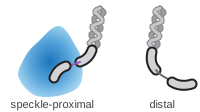
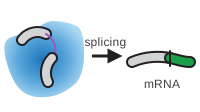
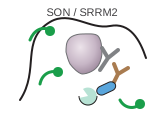
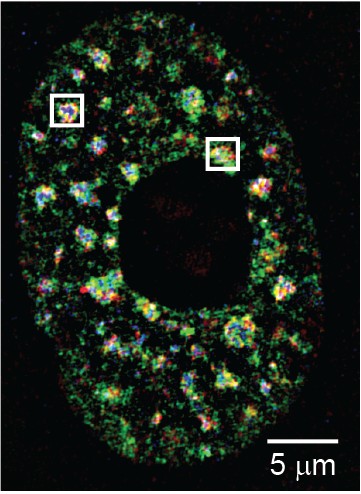
We focus on nuclear speckles, which are built on the scaffold proteins SON and SRRM2 and enriched in spliceosomal components, splicing factors, polyadenylated RNAs and certain lncRNAs. We have mapped the speckle transcriptome and found that speckle localization is tightly linked to splicing efficiency. We have also shown that speckles have a layered internal organization that positions RNA substrates at their surface. We are now working out the sequence rules that send an RNA to speckles, and the functional consequences of getting there.

MLOs are also increasingly linked to human disease. Nuclear speckles have been implicated in neurodegenerative diseases, infectious diseases and cancers. RNAs carrying disease-associated repeat expansions, such as CAG repeats in Huntington's disease and CGG repeats in fragile X-associated tremor/ataxia syndrome, accumulate at speckles, as do influenza A viral RNAs. Many diseases also stem from mis-splicing. Yet direct evidence for how speckles contribute to RNA metabolism and to disease is still lacking. Filling in these mechanistic gaps is a central goal of our work, and may reveal new ways to modulate RNA localization and splicing.
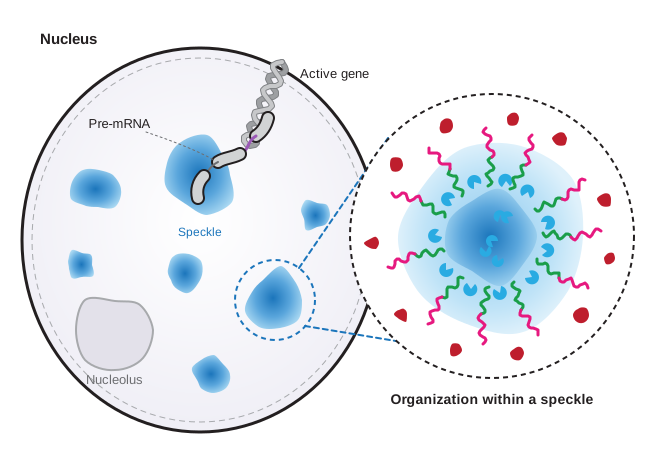
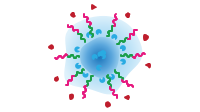
Schematic of a nucleus with nuclear speckles, an active gene producing a pre-mRNA that reaches a speckle, and a zoom-in showing RNAs organized at the speckle surface. Legend: SR protein, hnRNP, SON/SRRM2 core, RNA with SR-protein and hnRNP binding motifs
Transcripts from speckle-proximal genes enter nuclear speckles, where RNAs are organized with SR-motif regions facing inward and hnRNP-motif regions facing outward.
Core question

What are the rules and mechanisms of RNA localization? How do MLOs and localized RNAs drive function or dysfunction in cells?

What we aim to learn

Rules of localization

Which transcripts go to speckles, and why. Gene position relative to speckles, GC content, intron length and splicing features all help predict speckle enrichment.

Speckles and splicing

How speckle localization boosts intron removal, regulates intron retention and favors exon inclusion, and how this changes under stress.

Organization within organelles

How RNA–protein interactions arrange RNAs and proteins into layers inside speckles, and whether different sub-domains carry out different functions.

Our approaches

Localized transcriptomics

In situ reverse transcription-based sequencing methods to map which transcripts reside in nuclear speckles and other organelles, and how that changes with cell state.

Super-resolution image of a nucleus showing MALAT1, U2 and SRRM2 in nuclear speckles

Single-molecule & super-resolution imaging

Visualizing individual RNAs and proteins in and around organelles at nanometer resolution to resolve their internal organization and dynamics.

Selected publications

All publications →
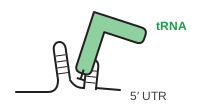
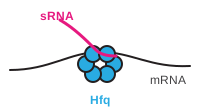
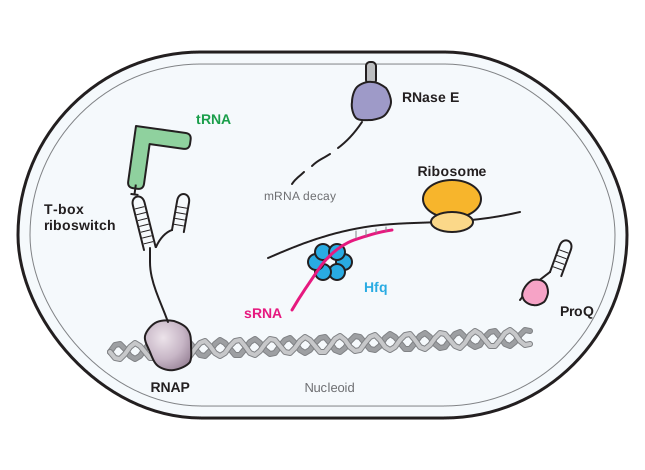
Schematic of a bacterial cell: a T-box riboswitch on a nascent transcript binds tRNA; an sRNA pairs with an mRNA on the chaperone Hfq; a ribosome translates; RNase E at the membrane degrades mRNA; ProQ binds a structured RNA.
Regulatory RNAs and their protein partners control gene expression inside the bacterial cell.
Bacterial regulatory RNAs

Kinetic mechanisms of bacterial regulatory RNAs

Diverse regulatory RNAs help bacteria respond to changing signals, and they support survival during infection, biofilm formation and antibiotic stress. This makes essential bacterial RNAs attractive potential drug targets, but targeting them depends on a precise understanding of how they work.

We study the kinetic mechanisms of both cis-acting regulatory RNAs, focusing on riboswitches in the 5′ UTRs of mRNAs, and trans-acting small RNAs (sRNAs) and their chaperones Hfq and ProQ. In vitro, we use single-molecule FRET to follow how a riboswitch recognizes its ligand. In live cells, we combine quantitative imaging with modeling to measure how RNAs compete for shared proteins and targets. Together, this work shows how regulatory RNAs read cellular physiology to control gene expression.

Core question

How do regulatory RNAs sense the state of the cell, and how do binding kinetics and competition inside a crowded cell decide which genes are regulated, and when?

What we aim to learn

Riboswitches (cis-acting)

How T-box riboswitches decode the tRNA anticodon and sense its aminoacylation state, with kinetics tuned to transcriptional or translational control.

Small RNAs & chaperones (trans-acting)

How sRNAs and mRNAs compete for Hfq and ProQ in live cells, and how stress redirects these chaperones toward sRNA-dependent regulation.

Regulation in time

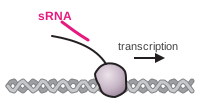
How binding rates set regulatory priority among an sRNA's targets, including co-transcriptional regulation by sRNAs long thought to act only after transcription.

Our approaches

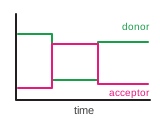
Single-molecule FRET

Real-time conformational dynamics and binding kinetics of riboswitch–ligand interactions.

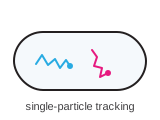
Live-cell single-molecule imaging

Super-resolution imaging and single-particle tracking of RNAs and chaperones in bacterial cells.

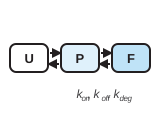
Quantitative kinetic modeling

Mathematical models that turn imaging data into rate constants for regulation in vivo.

Selected publications

All publications →

Interested in joining us?

We welcome students and postdocs from biology, chemistry, physics and mathematics.

Open positions →